Saturday, May 30, 2009

Tiny Porous Nano-Spheres Carry 2 Drugs at Once

Ames Lab researchers at Iowa State University continue their work with porous silica nano-spheres as drug delivery systems. This time, they have devised nano-systems capable of delivering two different drugs simultaneously.
A boronic acid-functionalized mesoporous silica nanoparticle-based drug delivery system (BA-MSN) for glucose-responsive controlled release of both insulin and cyclic adenosine monophosphate (cAMP) was synthesized. Fluorescein isothiocyanate-labeled, gluconic acid-modified insulin (FITC-G-Ins) proteins were immobilized on the exterior surface of BA-MSN and also served as caps to encapsulate cAMP molecules inside the mesopores of BA-MSN. The release of both G-Ins and cAMP was triggered by the introduction of saccharides. The selectivity of FITC-G-Ins release toward a series of carbohydrate triggers was determined to be fructose > glucose > other saccharides. The unique feature of this double-release system is that the decrease of FITC-G-Ins release with cycles can be balanced by the release of cAMP from mesopores of MSN, which is regulated by the gatekeeper effect of FITC-G-Ins. In vitro controlled release of cAMP was studied at two pH conditions (pH 7.4 and 8.5). Furthermore, the cytotoxicity of cAMP-loaded G-Ins-MSN with four different cell lines was investigated by cell viability and proliferation studies. The cellular uptake properties of cAMP-loaded FITC-BA-MSN with and without G-Ins capping were investigated by flow cytometry and fluorescence confocal microscopy. We envision that this glucose-responsive MSN-based double-release system could lead to a new generation of self-regulated insulin-releasing devices. _ACS
The ability to release two interacting substances from separate compartments in a nano-delivery system, provides for much longer shelf life and greater potency at the time of delivery. In this case, the payoff will be stop-gap implantable blood glucose regulation.

For long term control of diabetes, working cellular systems that can synthesise their own insulin are preferable to artificial systems. In general, the same principle is valid for all replacement organs and systems.

Replacement parts that can repair themselves, and work in concert with the rest of the body, are preferable to "one trick pony" replacements that too easily give out.

Almost certainly the best use of the Ames nano-spheres will be for genetic therapies to permanently alter gene expression of cells and tissues. But for now, proving the extent of functionality of this delivery system remains important.

Labels: ,

Tuesday, November 11, 2008

MK-677, Oral Ghrelin Mimetic, Stimulates Youthful Pulsatile HGH Secretion in Elderly

Via NextBigFuture, this Annals of Internal Medicine article looks at the effect of an oral ghrelin mimetic on secretion of HGH, and various physical measurements such as muscle mass, visceral fat, etc.
Conclusion: Over 12 months, the ghrelin mimetic MK-677 enhanced pulsatile growth hormone secretion, significantly increased fat-free mass, and was generally well tolerated. Long-term functional and, ultimately, pharmacoeconomic, studies in elderly persons are indicated.

Previous trials in which growth hormone was administered to elderly persons were small, poorly controlled, or too short (8); in addition, growth hormone replacement does not restore pulsatile growth hormone secretion. MK-677, the first orally active ghrelin mimetic (a growth hormone secretagogue and growth hormone secretagogue–receptor agonist), increases pulsatile growth hormone secretion in older adults to levels observed in young adults (9, 10). Our primary objectives were to determine whether 25 mg of oral MK-677 daily would increase growth hormone and insulin-like growth factor I (IGF-I) levels in healthy older adults, prevent the decline in fat-free mass, and decrease abdominal visceral fat, with acceptable tolerability.

...Frailty is one of the scourges of elderly persons, and as researchers are beginning to learn about its causes, they are asking whether growth hormone deficiency is one of them. A systematic review (8) concluded that the risks of exogenous growth hormone outweigh the benefits and that it is not the long-sought solution to frailty. The promise of MK-677 is that it seems to restore endogenous growth hormone levels in a physiologic secretory pattern, unlike the single high-amplitude pulse observed after exogenous growth hormone administration. We believe that our study sets the stage for an adequately powered clinical trial of sufficient duration in a population vulnerable to frailty. _AnnalsIntMed
The effects of the more physiologic pattern of HGH secretion seen in MK-677 recipients vs. standard HGH replacement protocols, suggests that more indirect route of using an oral ghrelin mimetic may provide better long-term results.

The most significant adverse effect was an increase in appetite, which in many elderly might be seen as more of a positive miracle than an adverse effect. I encourage anyone interested to go to the article itself and read it in full. The complexity of homeostasis in the human organism should discourage simplistic and cavalier interventions for purposes of senescence mitigation. The study quoted above is a good example of a thoughtful and fairly comprehensive look at a measured intervention. The findings should be confirmed and integrated into the leading theories of senescence mitigation and reversal.

Labels:

Sunday, January 21, 2007

Hormone Replacement: Some People Think It Works


A recent meta-analysis of Human Growth Hormone (HGH) effect on mortality and morbidity painted a pessimistic picture. Certainly a lot of "science" blogs jumped on the story and instantly turned "thumbs down" on HGH replacement. Personally, I say "not so fast." Meta-analysis studies such as this cannot provide a definitive answer to a question. They can only suggest new approaches to experimental study.

While anecdotal evidence is not proof of any scientific principle, some may find it interesting to see examples of "successful" treatment with hormone replacement. These two videos are promotional videos by a hormone replacement clinic in Palm Springs, California. This clinic has been in business for over a decade now.
Total Hormone Therapy Vid. 1
Total Hormone Therapy Vid. 2

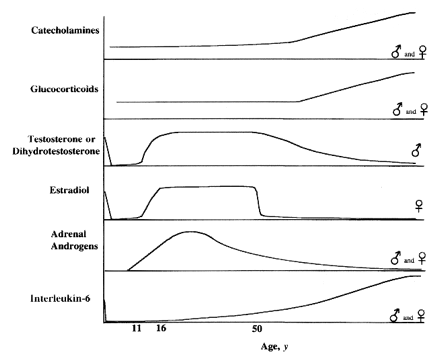
The concept of hormone replacement therapy is simple. HGH, DHEA, Thymosin, male and female sex hormones, and often Thyroxin will fall in concentration with age. To better approximate the physical condition of a younger person, you would theoretically want to replace hormones that tend to drop off in concentration dramatically with age. You would also want to see a drop in the pro-inflammatory and other harmful hormone levels that rise with age, at the same time.

It is not proven to work, other than anecdotally. But the idea deserves better experimental analysis than it has received so far, at least in the US.

Labels:

Monday, June 26, 2006

Glimpses Into the Near Future

The master control program for development and repair of the human organism is being de-encrypted. Using tools from genetic programming, stem cell research, and nanotechnology, it will be possible to assist the body in maintaining health and youth. Here is a brief progress report for a few interesting tools and technologies:

Creating embryonic stem cell (ESC) lines is controversial. Destroying embryos to create a single ESC line strikes some as wasteful of human life. But what if you could take an embryo and create millions of distinct ESC lines from it?

This Nature abstract discusses the protein Nanog, which may allow the creation of any number of "hybrid" ESC lines-- reprogramming adult stem cells to pluripotency. Eventually it should even be possible to reprogram adult stem cells without having to use an ESC. Here is a bit more detail in this Bio.com newsrelease:

The Edinburgh scientists fused mouse embryonic stem cells with brain stem cells, a type of adult stem cell. They found that the addition of Nanog resulted in a massive increase in the numbers of hybrid cells, all of which behaved like embryonic stem cells. Most importantly the hybrid cells showed the capacity to make many different cell types, such as heart and gut. "This means that the genetic programme of the brain cells has been erased and replaced by the unspecialised programme of an early embryo cell" says Dr Jose Silva, first author of this study.

Dr Silva adds "The effect of Nanog is remarkable. All of the hybrid cells become fully converted to embryonic stem cells. If we can figure out how Nanog does this, it may become possible to switch cell types without fusion or cloning." However, the Edinburgh team must also identify at least one other key gene. "Nanog has great power" says Professor Smith, "but it does not work in isolation, only in partnership with other genes present in embryonic stem cells".

As an organism ages, it loses the ability to replace lost cells. At some point, cells lose the ability to replicate, but even before that point they show signs of incompetence in gene expression. This Nature abstract discusses research that reveals this increased variation in gene expression of aging myocytes:

One possible mechanism by which increased DNA damage could lead to cellular degeneration and death is by stochastic deregulation of gene expression. Here we directly test for increased transcriptional noise in aged tissue by dissociating single cardiomyocytes from fresh heart samples of both young and old mice, followed by global mRNA amplification and quantification of mRNA levels in a panel of housekeeping and heart-specific genes. Although gene expression levels already varied among cardiomyocytes from young heart, this heterogeneity was significantly elevated at old age. We had demonstrated previously an increased load of genome rearrangements and other mutations in the heart of aged mice3, 4.

This means that in order to perform DNA repair on senescent cells, it will be necessary to have templates of relatively young cells of that type. At some point it would be necessary to replace the old cells with new cells--much like replacing the rotten planking of an old wooden boat with new planking. It is still the same boat, but the new planking gives it a new life. Stem cells--tissue specific programmed ASC's from preserved ESC's--would provide the replacement cells.

That is why drugs such as the recent Korean discovery CGK-733 will not work as life extenders. They only extend the replication lifetime of cells--they do not keep the ageing cells young. The senescent incompetence of gene expression is still present, along with increasing risks of cancerous transformation.

Next, what good is a body made of young vibrant cells, if the mind is asleep or deranged? This Eurekalert newsrelease discusses the discovery of Neuropeptide-S, a new brain protein that promises to help wake the walking sleepers.

Neuropeptide S (NPS), so named by Rainer K. Reinscheid, Ph.D., assistant professor, Program in Pharmaceutical Sciences, University of California, Irvine, is produced by a small cluster of cells in the brainstem, yet its specialized receptors are found in several areas of the brain, including those that are associated with the regulation of arousal, sleep and wakefulness, anxiety, appetite, learning and memory. Dr. Reinscheid and his colleagues reported finding the new neuropeptide just last year and described animal studies showing how binding of NPS to its receptors on the surfaces of neurons promotes strong arousal, suppresses all phases of sleep and lessens anxiety in stressful or unfamiliar situations.

Now, at ICN 2006, Dr. Reinscheid's group reports how NPS also can reduce the biochemical and behavioral symptoms of schizophrenia in an established animal model for this mental illness that affects some 2 million Americans. Animals pretreated with NPS before receiving a drug that normally induces psychotic-like behaviors did not develop the signature behavioral symptoms and neurochemical features of schizophrenia, reported Naoe Okamura, M.D., Ph.D., who is a co-worker of Dr. Reinscheid at the University of California, Irvine.

"Although preliminary, our animal studies indicate the NPS receptor should be explored as a target for the development of novel antipsychotic drugs. Whether molecules activating the NPS system will prove to be better drugs than others used to treat the symptoms of schizophrenia remains to be seen. We still have a very long way to go before proving it can alleviate symptoms in humans as we've seen it do in rodents," said Dr. Reinscheid.

A peptide that wakes people up, and makes them less anxious and perhaps less psychotic too? Quite the improvement over amphetamine. Perhaps exactly what is needed in the coming age of tumultuous transition to a next level world.

Some nanotechnologists and singularitarians believe that tiny nanobots will be able to store and carry the early genome to all cells, and busily repair any errors that may occur in replication--even in ageing cells. Such nanobots could conceivably detect early cancerous transformation, and act to trigger apoptosis in cells with such changes.

Research in biotechnology is now at such a profound level, that breakthroughs in one are can quickly lead to breakthroughs in several other areas. It is obvious that ageing is related to malignancy as well as autoimmune and other inflammatory diseases. In addition, improvements in the tools of biotechnology research almost immediately suggest newer and more profound areas of research and discovery. It is becoming easier to believe Ray Kurzweil's analysis of exponential knowledge growth.

Now, two more postings on aging: the first deals with mitigating the effects of aging in those already old. The second posting will deal with new theories of cryopreservation that may finally provide a workable way forward to safely place people into "stasis" for later "re-animation".

A compound that stimulates the secretion of growth hormone can help older adults improve their physical function and lower their body fat percentage, according to study results that will be presented Wednesday, June 21, at the International Congress of Neuroendocrinology in Pittsburgh. The results will be presented by Dr. George Merriam, professor of medicine at the University of Washington and a physician with the VA Puget Sound Health Care System. Merriam helped coordinate endocrine aspects of this multi-site study, along with Dr. Heidi White of Duke University and researchers at Pfizer, Inc. Nearly 400 adults from 65 to 84 years old were enrolled in the study, and were divided into groups receiving a placebo or one of four different levels of an oral growth hormone secretagogue (GHS), which stimulates the secretion of human growth hormone. Researchers measured the participants' fat and lean body (muscle) mass, as well as their performance in physical tests like stair climbing and a heel-to-toe walk. The participants also received blood tests for levels of growth hormone and a compound called IGF-1, a hormone which responds to growth hormone and mediates some of its effects. Participants receiving the GHS treatment saw a significant increase in lean body mass – about 1.5 kilograms, or 3.3 pounds. The GHS treatment led to improved physical function over the six- to 12-month study period. Participants also had higher levels of growth hormone and IGF-1 in their bloodstreams. Patients receiving the GHS treatment had minor side effects, including increased fatigue, insomnia, and fasting glucose levels. Growth hormone is vital in childhood growth, and production of the hormone peaks during puberty. However, it continues to affect physical function throughout our lives, and it regulates metabolism and body composition. As adults move into middle age, growth hormone production begins to taper off. Many of the effects of aging – increased abdominal fat, reduced muscle mass, and decreased physical function – look very similar to the symptoms of growth hormone deficiency in younger people. As those aging effects set in, many older adults find it difficult to care for themselves, and they lose quality of life and often turn to long-term care. Source.

Last, new ideas on cryopreservation:

In medicine, cryopreservation involves preserving organs and tissues for transplantation or other uses. Only certain kinds of cells and tissues, including sperm and embryos, currently can be frozen and successfully rewarmed. A major problem hindering wider use of cyropreservation is formation of ice crystals, which damage cell structures. Cyropreservation may be most familiar, however, as the controversial idea that humans, stricken with incurable diseases, might be frozen and then revived years or decades later when cures are available. Bogdan's experiments involved a form of water termed "glassy water," or low-density amorphous ice (LDA), which is produced by slowly supercooling diluted aqueous droplets. LDA melts into highly viscous water (HVW). Bogdan reports that HVW is not a new form of water, as some scientists believed. ...."It may seem fantastic, but the fact that in aqueous solution, [the] water component can be slowly supercooled to the glassy state and warmed back without the crystallization implies that, in principle, if the suitable cyroprotectant is created, cells in plants and living matter could withstand a large supercooling and survive," Bogdan explained. In present cryopreservation, the cells being preserved are often damaged due to freezing of water either on cooling or subsequent warming to room temperature. "Damage of the cells occurs due to the extra-cellular and intra-cellular ice formation which leads to dehydration and separation into the ice and concentrated unfrozen solution. If we could, by slow cooling/warming, supercool and then warm the cells without the crystallization of water then the cells would be undamaged." Source: American Chemical Society More at source.

In the future, several approaches to aging will be available. Those who choose to age "normally" will have the option of "optimising their years" without adding to them appreciably. HGH promoters, pumps, and depo injections will be useful for them. Others will want to add a few decades of high functioning years to their lives. For those, drugs that aid in DNA repair, protein crosslink repair, calorie restriction mimetics, and anti-oxidant/anti-inflammatory supplements will probably do the trick. For those who want more radical extension to their lives, SENS-like approaches to rejuvenation engineering may eventually pay off. Stem cell repair and organ re-growth will definitely be available in the next few decades. More cyborg replacement parts will also be available in the next half century. The grand strategy is genetic engineering of a longer living body that rejuvenates itself constantly, and heals rapidly when injured.

Should safe and reliable cryogenics become available before the more radical lifespan extension strategies, it is conceivable that some might opt to be placed in "suspended animation" until the technologies for longer life are perfected. That might be particularly true for those dying prematurely of terminal illnesses.

Research into these technologies is being funded, sometimes under other descriptions. It is very likely that the goal of doubling the human lifespan will be achieved before the end of the century. Perhaps before the midpoint of the century.

Labels: , , , , ,

Friday, April 21, 2006

Longevity and Life Extension: Getting the Jump on Aging Before SENS

Many of you are familiar with Aubrey de Grey and his SENS approach to life extension and longevity. For the intermediate term, de Grey's approach offers a lot of promise in the fight against aging.

In the short term, we need something more immediate. Ray Kurzweil has written a book on aging, discussing the several dozen supplements he takes daily. Most people do not need that much, but some might need more. A recent Barron's article took a stab at the subject, but journalists have trouble getting to the meat of a topic.

This brief posting will deal with the basics of life extension now, rather than longevity in the next fifty years. Several postings in Al Fin have dealt with this topic, and there is no need to repeat them. This is just the basics. People below the age of 40 should ignore the hormone section. Each person should selectively choose agents based upon his own circumstances. Inform yourself in basic biology. Consult professionals before taking prescription medicines or extremely high doses of any agent. DHEA and androgens can potentially accelerate the development and spread of prostate cancer, so be sure and be screened appropriately if you are in the susceptible age group of males.

1. Hormones: DHEA, HGH, androgens, estrogens, thymosins, melatonin, and thyroid.
2. Antioxidants: Vitamins A,C,E, Lipoic Acid, Selenium, NAC, CoQ10, polyphenols, other phyto-antioxidants.
3. Antiglycation agents: Aminoguanidine, Carnosine, pyridoxamine, benfotiamine, ALT 711.
4. Brain Boosters: Ginkgo, PS, bacopa, DMAE, neurotransmitter precursors, hydergine, vinpocetine, Huperzine, etc.
5. Calorie restriction mimetics such as resveratrol, quercetin, etc.
6. General: TMG, Curcumin, carnitine, B complex, etc.
5. Immune Boosters: Wide variety of herbals and complex carbohydrate derivatives of plants and microorganisms, plus a lot of laughter.
6. Physical exercise and prudent eating, plus elimination of clearly bad habits and institution of good lifestyle habits.
7. Mental and emotional training. Practise sentic cycles and other forms of meditation. Read books on mind and memory training, and practise exercises.

If you are too old to wait for SENS, but rebel against the need to practise self-discipline, simply get old as you are doing. Otherwise, consult the longevity links posted on the side-bar of the Al Fin main page. Learn what you can, and start practising what you can. The important thing is to take a systematic approach. If you pop a lot of pills, but smoke like a stack, drink like a fish, exercise less than a minute a week, and sleep only two or three hours a night, you may not be taking a balanced approach to the subject.

In a later post, I will go into more detail on some of the particular agents and approaches outlined above. In the meantime, feel free to utilise the source materials that are provided. Aging and life extension are hot topics these days. I wonder why?

Labels: , , , , ,