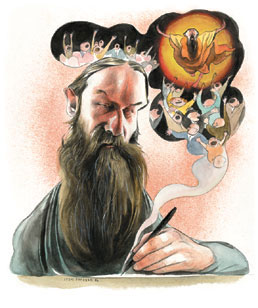
Aubrey de Grey's Ending Aging

I recently had the opportunity to read Aubrey de Grey's briskly selling book, Ending Aging.
The book goes into more detail about the 7 approaches to anti-senescence discussed at the SENS website. Consider a progress report on a very important front of scientific research. Arnold Kling takes an economist's look at the book, and is intrigued:
Four years ago, I reported that de Grey foresees a not-too-distant future in which humans can reverse the effects of aging, raising the possibility of living healthy lives for hundreds of years. He has not backed away from that position, and this book, written by de Grey and his research associate Michael Rae, represents an update from his perspective. In brief, he says thatTCS
1. The latest scientific research indicates no flaws in the theory that aging can be eradicated.
2. However, getting the required techniques developed will require institutional changes relative to our current system for conducting medical research.
As an economist, I am most interested--and most qualified to form an opinion about--the second point.
...De Grey sees aging as a byproduct of an evolutionary process that takes place within the body. Mutations occur over time within your cells, sometimes randomly and sometimes stimulated by external events. This evolutionary process changes the balance between what I might call "good stuff" and "bad stuff" (here I am taking the technical caliber of the scientific exposition down several levels). Sometimes, the "good stuff" gets stronger, as when we develop an immunity to a disease. More often, however, the "good stuff" gets weaker and the "bad stuff" (like arterial plaque or pre-cancerous cells) gets stronger. It is this shift in the balance that leads to the symptoms of aging, including susceptibility to disease, which ultimately proves fatal.
Because aging is a natural outcome of the body's internal evolutionary processes, de Grey argues that the standard paradigm for fighting the diseases of aging one by one is flawed. Prevention of one disease, in the form of slowing the processes that cause it, is a doomed strategy.
...Too often, academics use their credentials to spit out biased polemics dressed up as science. Ending Aging is the opposite. It is a crash course in state-of-the-art science dressed up as a polemic. De Grey wears his passion for undertaking a war on aging on his sleeve, yet most of the book consists of scientific analysis that, although simplified to enable a layman to follow, is conscientious in reporting doubts and objections to the author's point of view.
...What de Grey is saying is that today's cautious approach to experimental medical testing significantly slows the rate of progress, which means that many people will suffer and die unnecessarily. However, those people are unseen and unknown, whereas those who suffer and die as a result of medical experiments are identifiable and visible. I think that trying to sell people on the idea of taking more risks in order to advance medical progress is not as straightforward as de Grey makes it sound
...My guess is that de Grey will have better luck if he tries to mobilize wealthy philanthropists. If instead of donating buildings to universities our billionaires would donate money for prizes that reward general-purpose medical technologies, we might not have to wait for government research to adopt a paradigm shift, which is almost surely not going to happen. Wealthy (and not-so-wealthy) philanthropists who are reading this should check out de Grey's organization SENS and look for ways to contribute both to his institute and to a prize fund.
Future research will make part of de Grey's program moot and unnecessary. Other future research will likely incorporate some of de Grey's ideas. The point is, de Grey's approach is the best one currently operating, so that if someone did have extra money he/she was thinking about donating to science, they could do much worse than to donate to SENS.
I recommend the book to anyone interested in the extension of healthy human lifespan. Getting much of the same information from the SENS website + literature searches is possible, but you wouldn't want to miss Aubrey's unique argumentative style.
Labels: aging, Aubrey de Grey, gerontology, life extension
posted by al fin at
1:08 PM
0 Comments